Why Entrepreneurs Should Learn to Delegate
March 21, 2024
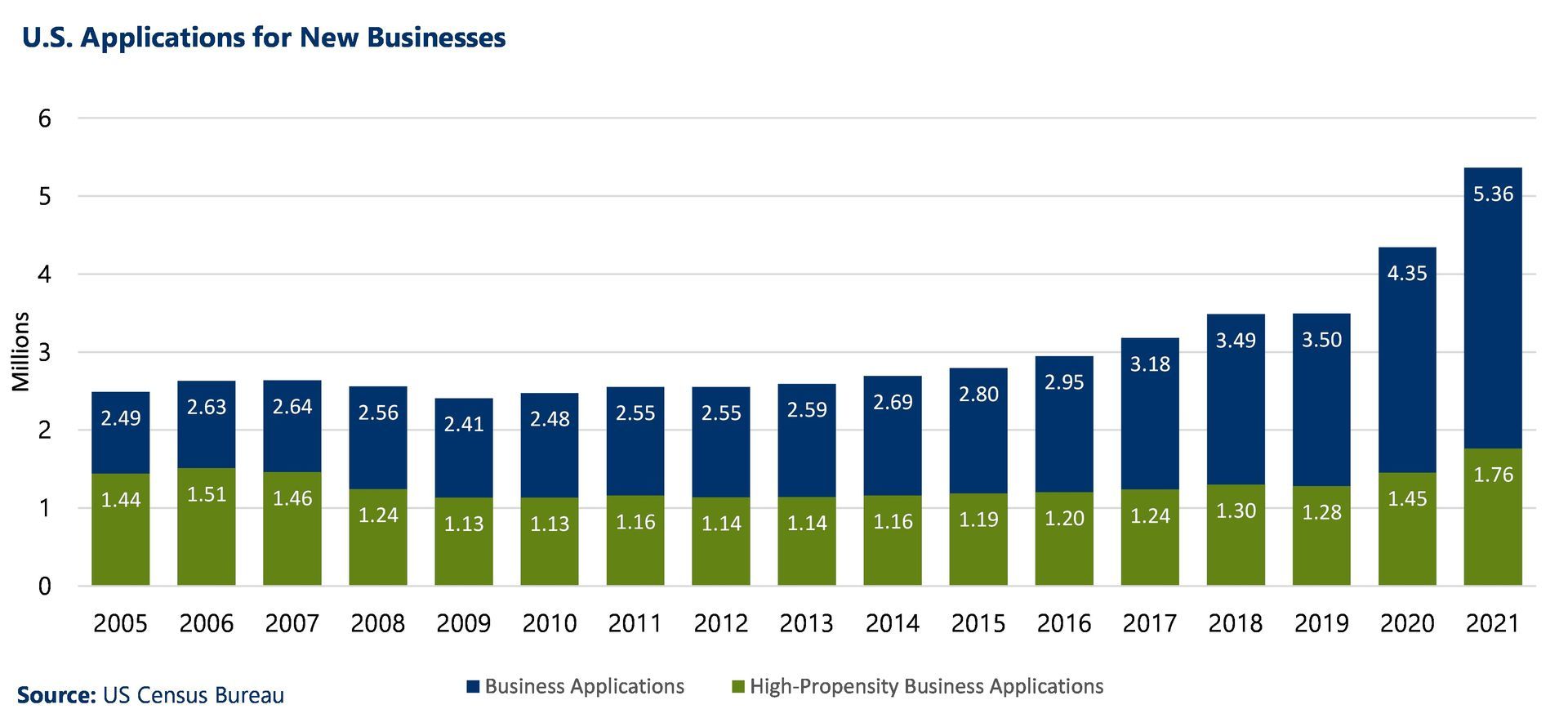
According to estimates from the Financial Times, there are over 500 million entrepreneurs on planet earth. This figure includes new business start-ups that emerged during the Covid-19 pandemic. Since the start of the pandemic, several countries have experienced a boom in new business formation. The US Chamber of Commerce reports that 5.5 million new business applications were filed in 2023 in the United States, setting a new record. The U.S. Census Bureau also indicates a continuous increase in the number of new business applications during the past few years. Entrepreneurship is on the rise.
For many aspiring entrepreneurs and new business owners, establishing their own business offers the opportunity to pursue their passion, be their own boss, and have greater autonomy. However, many entrepreneurs often times do not have experience managing various aspects of a business, including managing people. As such, as they attempt to scale their operations and grow their business, they often encounter challenges.
As someone who has served as consultant to entrepreneurs and small and mid-sized organizations (SMEs) across different countries, I have learned that people decisions are the most crucial to the success of any enterprise. A small business can potentially develop and offer the ideal product or service that meets the needs of the market. But in the long run, if the entrepreneur or small business owner does not learn how to manage people, may that be 5 or 25 staff members, the organization will encounter critical issues that will impede its growth and development.
Entrepreneurs tend to be passionate individuals who are committed to achieving success and offering value to their customers. Many entrepreneurs also enjoy the sense of being independent and having autonomy to decide what is best for their business. And as founders and owners of organizations they certainly have the right to choose how to manage them. But in the pursuit of independence and autonomy lies the danger of potentially not including others in the organization in critical decisions that affect the organization.
Working with entrepreneurs for several years has taught me that those who are most successful do not try to do everything on their own. They are comfortable delegating some tasks and responsibilities. The most effective entrepreneurs also make efforts to enrich their employees’ knowledge, skills, and understanding of the organization and industry. They assign important projects to them and include them in planning and strategic decisions. Effective entrepreneurs give their people opportunities to comment on processes, activities and systems, so that they are inclined to seek ways to improve them.
In my years of consulting, I have learned that entrepreneurs must learn to trust their people with important decisions and grant them greater responsibilities so as to prevent the organization’s culture from becoming satiated with conformity, inflexibility, and risk aversion. Entrepreneurs must learn to trust their people to take the initiative and introduce change. Promoting trust, delegating responsibilities, and holding people accountable will help develop people into leaders.
In spite of the complexity and rigor of managing the day-to-day operations, entrepreneurs must also make time to plan for the future and unify the team around long-term goals. Entrepreneurs should stimulate critical thinking across the organization, and encourage problem solving and the exploration of multiple solutions. Dialogue should be promoted to give everyone in the organization an opportunity to voice their opinion and contribute to the enterprise. Entrepreneurs should also make an effort to encourage employees to challenge the status quo and think of ways to enhance existing processes, activities, and products.
It is also important that entrepreneurs continually listen to their employees. Valuable lessons can be learned if one simply listens attentively. Asking questions and listening to employees not only will inform entrepreneurs, but will also serve to build employees’ morale, which can then increase motivation, and in turn increase performance. I believe that employees value an entrepreneurial leader who takes time to ask questions and listen. Hence, I would encourage entrepreneurs to make a conscientious effort to listen to their team.
Several successful entrepreneurs I have met followed the motto: “Never ask anyone to do something I am not willing to do myself”. Many of us admire leaders who are not afraid to get their hands dirty and put in the work. Diligence is admirable. However, it is important to realize that the entrepreneur cannot and should not try to do everything under the sun. I have met some entrepreneurs who have tried to handle every task and make every organizational decision from product design to marketing strategy to payroll. And although these entrepreneurs believed they were being productive; they were inadvertently creating a culture where others did not feel comfortable sharing ideas or taking any initiative. Some entrepreneurs unwisely believe that the best way to lead the organization is to do everything by oneself, and thus they are often reluctant to delegate work.
Entrepreneurs need time to decompress and re-energize, and attempting to tackle every issue and manage every task will not allow the entrepreneur to take time to think and reflect, and even get some needed sleep. It is vital that entrepreneurs take time to slow down and contemplate. Delegating some tasks can free up some time to give thought to important questions and issues related to the enterprise. Moreover, entrepreneurs also have the responsibility to lead their team and to model behavior that will be conducive to effective teamwork and high performance. And in order to accomplish this, entrepreneurs need to learn to delegate and model the behavior of entrusting tasks and responsibilities to others.
Every employee has the potential to make a difference. And entrepreneurs can foster an environment where people are able to contribute. Empowered individuals are more likely to generate creative ideas and solutions. As such, innovation and creativity should be encouraged and promoted in the startup, scaleup, and scaler organization because they can become continuous sources of growth and improvement.
Entrepreneurship is complex and demanding. But learning to delegate can help alleviate many of the issues that entrepreneurs and small organizations face. Entrepreneurs can certainly learn to manage people and organizations. And learning to delegate is an important step towards effectively managing an organization, and building a sustainable enterprise.
References Financial Times. (2020, December 29). Pandemic triggers surge in business start-ups across major economies. Valentina Romei. Retrieved from https://www.ft.com/content/3cbb0bcd-d7dc-47bb-97d8-e31fe80398fbU.S. Chamber of Commerce. (2024, February 02) New Business Applications Surge Across the Country. Stephanie Ferguson and Lindsay Cates. Retrieved from https://www.uschamber.com/small-business/new-business-applications-a-state-by-state-view
U.S. Census Bureau. Business Formation Statistics. Retrieved from https://www.census.gov/econ/bfs/index.html

Peter Drucker’s memoir, Adventures of a Bystander, is a self-portrait of a most unusual kind. It reveals its subject not through direct autobiography, but through a series of incisive portraits of the people he encountered throughout a tumultuous life. Drucker positions himself as a "bystander," but this is no passive observer. Instead, he is an intellectual portraitist whose careful study of others becomes the very method by which he comes to understand himself and the fractured world he inhabited.

This essay was inspired by an article recently published by Karen Linkletter and Pooya Tabesh (2025). They were in search of the meaning of “decision” in the works of Peter Drucker. To this end, they used Python to identify and locate all the times the word, “decision”, came up in Peter Drucker’s oeuvre . They then characterized the contexts (“themes”) in which the word came up. The result was a nuanced but very clear characterization of the evolution of his thinking on the topic. Here, we will focus on a key theme for Drucker: the case where your decisions involve other people’s decisions and actions . For present purposes, we can start with their statement: One of Drucker’s valuable contributions to the literature on decision-making is his adamance that implementation be built into the decision-making process.” (Linkletter and Tabesh 2025 8) To be clear, “…it is not a surprise that his integration of implementation of and commitment to decisions is part of his process of decision-making. He argues that a decision “has not been made until it has been realized in action.” (2025 8) The question, therefore, is how to make this happen, how to turn an organization from an aggregate of individuals whose decisions may or may not be aligned, into an agent—an entity that makes decisions, implements them, and then ascertains that what was done was, in fact, what was decided, as we try to do when making purely individual decisions. Let’s look at the matter more closely… A few years ago, I read a story about a road crew that was painting a double-yellow line on a highway. In their path was a dead raccoon that had been hit by a car or truck. It was lying right in the middle of the road. The crew didn’t stop. Someone later took a picture of the dead raccoon with a double-yellow line freshly painted right over it. The picture is below. It went viral on the Internet.

When Paul Polman became CEO of Unilever in 2009, he did not inherit a troubled company. He stepped into a large global enterprise with familiar consumer brands that sat on shelves in cities from Amsterdam to Manila. Even with that scale and reach, the business rested on foundations that were beginning to crack. Public faith in multinational firms was fading, climate change was moving from a distant worry to a financial reality, and investors were increasingly locked into the rhythm of quarterly results that encouraged short term decisions and discouraged real strategy.

Peter Drucker suggested that readers view his first three books as a unified body of work: The End of Economic Man(1939), The Future of Industrial Man (1942), and Concept of the Corporation (1946). These works share a common theme: politics. Drucker did not think about politics like scholars who strictly follow modern social science norms. Instead, he viewed politics as part of social ecology and understood political events through the dynamic changes in social ecology. Despite having "corporation" in its title and using General Motors as a case study, Concept of the Corporation is indeed a book about politics. In this work, Drucker attempts to address the main issues that industrial society must resolve: the legitimacy of managerial authority, the status and function of managers and workers, and the power structure of society and organizations. In Drucker's own words, this is a book exploring the specific principles of industrial society. Corresponding to these specific social principles, Drucker had earlier attempted to develop a general social theory, which was the aim of The End of Economic Man and The Future of Industrial Man. The subtitle of The End of Economic Man is "The Origins of Totalitarianism." The book focuses on how society disintegrates in industrial societies and how totalitarianism rises. For Drucker, the real challenge of this topic isn't explaining how Hitler and Mussolini came to power, nor the actions of Germany and Italy in government, military, and economic spheres. Rather, it's understanding why some Europeans accepted clearly absurd totalitarian ideologies, and why others seemed potentially receptive to them. Drucker's writing style is argumentative. He clearly knew that to effectively advance his arguments, he needed to engage with popular theories of his time. Back then, there were two main explanatory approaches to Nazism and Fascism, which Drucker termed "illusions." Some viewed totalitarianism as ordinary political turmoil similar to previous historical revolutions. In their view, totalitarianism was characterized merely by cruelty, disruption of order, propaganda, and manipulation. Others considered totalitarianism a phenomenon unique to Germany and Italy, related to their specific national characters. Drucker thoroughly refuted explanations based on "national character." He believed that any historical approach appealing to "national character" was pseudo-history. Such theories always emphasize that certain events were inevitable in certain places. But all claims of "inevitability" negate human free will and thus deny politics: without human choice, there is no politics. If the rise of totalitarianism were inevitable, there would be no need or possibility to oppose it. Viewing totalitarianism as an ordinary revolution is equally dangerous. This thinking merely emphasizes how bad Nazis and Fascists were. But the real issue is that Europeans were not merely submitting out of fear—they were actually attracted to totalitarianism. And those attracted weren't just the ignorant masses but also well-educated intellectual elites, especially the younger generation. The world cannot defeat totalitarianism through contempt alone, especially if that contempt stems from ignorance. Understanding the enemy is a prerequisite to defeating it. Drucker identified three main characteristics of Nazism and Fascism (totalitarianism is a social type, with Nazism and Fascism being its representatives in industrialized Europe): 1. The complete rejection of freedom and equality, which are the core beliefs of European civilization, without offering any positive alternative beliefs. 2. The complete rejection of the promise of legitimate power. Power must have legitimacy—this is a long-standing tradition in European politics. For power to have legitimacy means that it makes a commitment to the fundamental beliefs of civilization. Totalitarianism denied all European beliefs, thereby liberating power from the burden of responsibility. 3. The discovery and exploitation of mass psychology: in times of absolute despair, the more absurd something is, the more people are willing to believe it. The End of Economic Man develops a diagnosis of totalitarianism around these three characteristics. Drucker offers a deeper insight: totalitarianism is actually a solution to many chronic problems in industrial society. At a time when European industrial society was on the verge of collapse, totalitarians at least identified the problems and offered some solutions. This is why they possessed such magical appeal. Why did totalitarianism completely reject the basic beliefs of European civilization? Drucker's answer: neither traditional capitalism nor Marxist socialism could fulfill their promises of freedom and equality. "Economic Man" in Drucker's book has a different meaning than in Adam Smith's work. "Economic Man" refers to people living in capitalist or socialist societies who believe that through economic progress, a free and equal world would "automatically" emerge. The reality was that capitalism's economic freedom exacerbated social inequality, while socialism not only failed to eliminate inequality but created an even more rigid privileged class. Since neither capitalism nor socialism could "automatically" realize freedom and equality, Europeans lost faith in both systems. Simultaneously, they lost faith in freedom and equality themselves. Throughout European history, people sought freedom and equality in different social domains. In the 19th century, people projected their pursuit of freedom and equality onto the economic sphere. The industrial realities of the 20th century, along with the Great Depression and war, shattered these hopes. People didn't know where else to look for freedom and equality. The emerging totalitarianism offered a subversive answer: freedom and equality aren't worth pursuing; race and the leader are the true beliefs. Why did totalitarianism reject the promise of power legitimacy? One reason was that political power abandoned its responsibility to European core beliefs. Another reason came from the new realities of industrial society. Drucker held a lifelong view: the key distinction between industrial society and 19th-century commercial society was the separation of ownership and management. The role of capitalists was no longer important. Those who truly dominated the social industrial sphere were corporate managers and executives. These people effectively held decisive power but had not gained political and social status matching their power. When a class's power and political status don't match, it doesn't know how to properly use its power. Drucker believed this was a problem all industrial societies must solve. Totalitarianism keenly perceived this issue. The Nazis maintained property rights for business owners but brought the management of factories and companies under government control. This way, social power and political power became unified. This unified power was no longer restricted or regulated—it became the rule itself. Why could totalitarianism make the masses believe absurd things? Because Europeans had nothing left to believe in. Each individual can only understand society and their own life when they have status and function. Those thrown out of normal life by the Great Depression and war lost their status and function. For them, society was a desperate dark jungle. Even those who temporarily kept their jobs didn't know the meaning of their current life. The Nazi system could provide a sense of meaning in this vacuum of meaning—though false, it was timely. Using the wartime economic system, the Nazis created stable employment in a short time. In the Nazi industrial system, both business owners and workers were exploited. But outside the industrial production system, Nazis created various revolutionary organizations and movements. In those organizations and movements, poor workers became leaders, while business owners and professors became servants. In the hysterical revolutionary fervor, people regained status and function. Economic interests were no longer important, freedom and equality were no longer important; being involved in the revolution (status) and dying for it (function) became life's meaning. The Nazis replaced the calm and shrewd "Economic Man" with the hysterical "Heroic Man." Though absurd, this new concept of humanity had appeal. What people needed was not rationality but a sense of meaning that could temporarily fill the void. Those theorists who despised totalitarianism only emphasized its evil. Drucker, however, emphasized its appeal. He viewed totalitarianism as one solution to the crisis of industrial society. From 19th-century commercial society to 20th-century industrial society, the reality of society changed dramatically. 19th-century ideas, institutions, and habits could not solve 20th-century problems. Capitalism could not fulfill its promises about freedom and equality, and neither could Marxism. It was at this point that totalitarianism emerged. Nazism and Fascism attempted to build a new society in a way completely different from European civilization. Drucker said the real danger was not that they couldn't succeed, but that they almost did. They addressed the relationship between political power and social power, proposed alternative beliefs to freedom and equality (though only negative ones), and on this basis provided social members with new status and function. The war against totalitarianism cannot be waged merely through contempt. Defeating totalitarianism is not just a battlefield matter. Those who hate totalitarianism and love freedom must find better solutions than totalitarianism to build a normally functioning and free industrial society. Totalitarianism gave wrong and evil answers. But they at least asked the right questions. Industrial society must address several issues: the legitimacy of power (government power and social power), individual status and function, and society's basic beliefs. These issues became the fundamental threads in Drucker's exploration of industrial society reconstruction in The Future of Industrial Man. The Future of Industrial Man: From Totalitarian Diagnosis to General Social Theory Both The End of Economic Man and The Future of Industrial Man feature the prose style of 19th-century historians. Even today, readers can appreciate the author's profound historical knowledge and wise historical commentary. For today's readers, the real challenge of these two books lies in Drucker's theoretical interests. He doesn't simply narrate history but organizes and explains historical facts using his unique beliefs and methods. In The End of Economic Man, Drucker developed his diagnosis of totalitarianism around three issues: power legitimacy, individual status-function, and society's basic beliefs. In The Future of Industrial Man, he also constructs a general social theory around these three issues. In "What Is A Functioning Society," Drucker explains three sets of tensions that exist in social ecology:

Last semester, two students approached me to advise their AI-based graduate projects at a time when no one else in the department was available or willing to take them on. Our department lacked sufficient faculty with software or AI specialization at the time to support the growing number of requests in this area.

When Marc Benioff founded Salesforce in 1999, Silicon Valley had a pretty straightforward playbook which was technological disruption at any cost. Profit, scale, and market capture dominated corporate ambition. Benioff, who worked under Steve Jobs at Apple and explored Buddhist philosophy, was not satisfied with that approach. He envisioned a company that would not only revolutionize enterprise software through the cloud but also redefine the social purpose of business itself. His leadership at Salesforce reflects Peter Drucker's concept of Management as a Liberal Art (MLA). This idea holds that management is not just about efficiency or growth, but about making work human, creating meaning, and building institutions that serve society (Drucker, 1989).

What is Soft Power?

Previously, I shared de Tocqueville’s concept of equality of condition and how it is manifesting in today’s perception that democracy has failed to deliver on its promise of economic and social equality for all. Promises of economic equality are impossible to fulfill; but democratic societies can and should offer all of their members dignity and a sense of purpose. In this final installment, I’ll share de Tocqueville’s prescriptions for shoring up the institutions of a democratic society – as well as some of his warnings about challenges that democracies face.

Over the past two decades, there has been a discernible shift in the professional workforce. Increasingly, individuals have chosen to leave traditional corporate environments in favor of smaller ventures, entrepreneurial efforts, and purpose-driven careers. This migration has been fueled by a desire for greater autonomy, meaningful impact, and freedom from the rigidity of hierarchical organizational structures. As the world continues to undergo sweeping changes—economic, technological, and social—professionals are finding themselves at a crossroads. The COVID-19 pandemic only accelerated this reckoning, forcing people across industries to reevaluate their relationship with work, identity, and independence.
In Part I of this series, I gave a brief overview of Alexis de Tocqueville’s background and project of evaluating American Democracy in the early 19 th century. In this new installment, I’d like to share de Tocqueville’s observations about the nature of equality in America and how what he saw might help us understand some of the challenges democracies face today.